After Dark on Ynys Môn: A Stargazing Weekend With a Warm Bed at the End of It
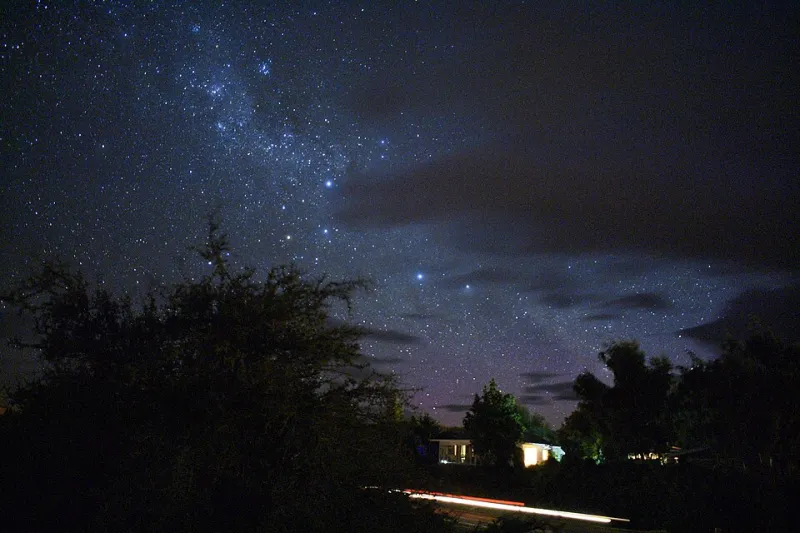
Photo: Sky_xe, CC BY-SA 4.0, via Wikimedia Commons
There is a moment, somewhere between the car park and the field gate, when your eyes give up on the torch and the sky takes over. It happens fast on Anglesey in winter. One minute you are picking your way along a track by the light of your phone; the next, the Milky Way is doing that thing where it looks less like stars and more like spilled milk across a dark table. It is worth the numb fingers.
The island is quietly excellent for this. Low light pollution, a big horizon, and a lot of coast facing nothing much at all. The trick is not finding dark sky — it is finding dark sky within a short drive of a decent dinner and a bed you do not have to pitch. Which is where the Black Lion comes in.
Why Anglesey Works After Dark
Most of Britain's stargazing advice points you at Exmoor, Kielder or the middle of Snowdonia. All good. But Anglesey has an advantage those places lack: it is flat-ish, coastal and small, so you can chase a clear patch of sky without a three-hour detour. Cloud dodging becomes a practical strategy rather than a fantasy.
The west and north of the island are the darkest corners, and anything facing out to the Irish Sea has an uncluttered southern and western horizon. On a clear, moonless night you can pick out the Andromeda galaxy with the naked eye if you know where to look, and the winter constellations — Orion, Taurus, the Pleiades — arrive early enough that you can be back in the pub before last orders.
When to Go (The Honest Answer)
Winter is the season, but it comes with a trade-off. November to February gives you the longest nights and the brightest stars, plus early sunsets that mean you are not forcing yourself to stay up until midnight. The catch is cloud. British winters are a lottery, and no amount of planning beats a look at the forecast on the day.
A few markers worth knowing:
- November is often underrated — mild enough to stand outside for an hour, dark by half five, and the Leonids and Taurids add a bit of drama.
- December brings the Geminids, usually the most reliable meteor shower of the year, peaking mid-month. Cold, but brilliant if the sky clears.
- January and February serve up the best of Orion and Sirius, and the coldest, clearest nights. This is where thermals earn their keep.
- Avoid the week either side of a full moon. You will still see plenty, but the whole point is the faint stuff.
Four Spots Worth the Drive
These are the sorts of places where a headtorch and a flask are the only company you will have.
Parys Mountain
The old copper workings outside Amlwch are strange in daylight and genuinely otherworldly after dark — a blasted, rust-coloured landscape with a horizon that opens up in every direction. There is a proper car park at the top, and the walk down towards the old windmill gives you big sky without a scramble.
The West Coast Dunes
The sand dunes and flat ground around Aberffraw and the Rhosneigr hinterland give you open sky and soft footing. Handy if you are carrying a tripod and a chair, and easy to retreat from if the cloud rolls in.
Holyhead Mountain and the South Stack Road
Park responsibly near the RSPB car park and walk a short way up the lane. You get the Irish Sea on one side and the mountain on the other, with the lighthouse beam sweeping through your long exposures. Bring a windproof layer; the breeze here is a personality trait.
Newborough and Llanddwyn
The forest and beach give you a dark, sheltered approach and a huge horizon over the water. A short wander past the trees puts the light of the car park well behind you. Come back in daylight too — it is one of the island's best walks.
What to Actually Bring
You do not need much, but the things you do need are non-negotiable:
- A red-light headtorch (or a bit of red tape over a normal one). White light wrecks your night vision for twenty minutes — yours and everyone else's.
- Layers, and more layers than you think. Standing still in a field in January is a completely different activity from walking in it.
- A flask. Tea, coffee, something with a bit of sugar in it.
- A camping chair or a sit mat. Standing and craning your neck gets old in ten minutes.
- Binoculars if you have them, plus a star app downloaded for offline use — half the fun is naming things.
- A tripod if you want photos, and a spare battery, because cold drains them.
The Weekend Plan
Arrive Friday afternoon, get the boots on for a short coastal leg-stretch before the light goes, then eat properly. After dinner, check the forecast, drive out to one of the spots above, and give it an honest hour. If the cloud wins, you have lost nothing but a bit of diesel and you are ten minutes from a fire and a pint.
Saturday is the flexible day. Walk in the morning, lunch at the Black Lion, then either nap or wander, depending on how the night before went. Saturday evening is your best shot at a long session — aim for somewhere with a low horizon and stay until your feet complain.
Sunday morning, if it is clear again, there is something quietly special about a pre-dawn sky with nobody about. Then breakfast, then home.
The Coming-In Bit
This is the part stargazing guides tend to skip, and it is the part that makes the weekend. Twenty minutes of standing in a dark field is a fantastic appetite builder. Coming back in, peeling off the coat, and finding a seat with something hot and a plate of proper food is the reason to do this from a pub rather than a tent.
There is also a practical advantage to sleeping above the pub: you are not driving home at midnight on a single-track lane with fogged-up windows, and you can have a whisky instead of a coffee at the end of the night. Small things. They add up.
A Little Manner in the Dark
Anglesey's dark skies are a shared resource, and the people who live here put up with a lot of summer traffic. Keep gates shut, park where you are not blocking a farm entrance, keep the radio off, and save the white torch for the car. And if a local tells you the cloud will lift by eleven, believe them.